


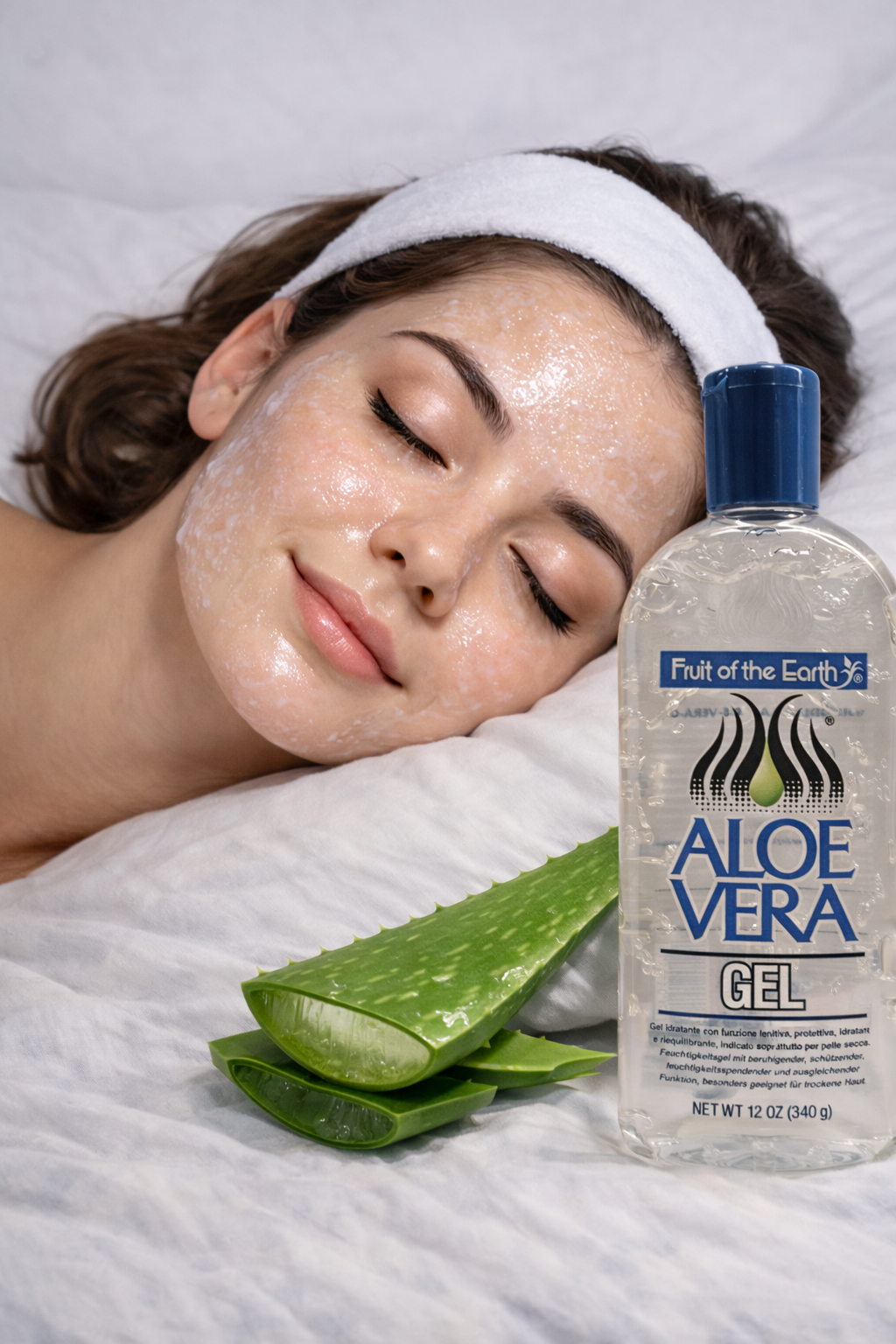
We have reached the final act of our scientific investigation into the potential of Aloe Barbadensis Miller in the skincare of 2026. After exploring the shield against Digital Aging (Part 1) and the Skin Microbiome Revolution (Part 2), we close the circle with the most visible and desired aspect: the biomechanics of aging and Aloe’s ability to act as a natural filler.
ApplyingAloe Vera to the face overnight is not just a superficial moisturizing gesture, but a deep “bio-restructuring” strategy. In this article, we will explore how the macromolecules in Aloe Alocambi interact with the dermis to plump up volumes and how the time-release technology ensures 8 hours of intensive treatment.
1. The Biomechanics of “Soft-Filler”: How Aloe Plumps Wrinkles
Unlike injectable synthetic fillers, which mechanically fill an empty space with foreign substances, Aloe Vera works on the principle of endogenous stimulation. The secret lies in the unique combination of Glucomannans, Gibberellin and Acemannan.
The Role of Fibroblasts and Collagen
Fibroblasts are the “factories” of youthfulness in our skin; they produce collagen, elastin and hyaluronic acid. Studies published in the Journal of Dermatological Science have confirmed that fibroblast receptors possess specific binding sites for Aloe mannose-polymers.
When we leaveAloe Vera on the face overnight, we activate a constant biochemical signal. This stimulation not only accelerates the synthesis of type I collagen, but also improves the organization of elastic fibers. The result in the morning is what dermatologists call a “plumping effect”: micro-wrinkles of expression appear visually relaxed because the internal structure of the skin has been temporarily “supported” by the deep hydration and new cellular boost.
2. Gradual Release Technology: 8 hours of Osmonotic Hydration.
One of the major limitations of traditional moisturizers is the speed of evaporation. Many emulsions provide immediate relief, but after 2-3 hours they leave the skin “exposed” right in the middle stages of sleep.
The molecular film of Alocambi
High-quality pure Aloe Vera, such as that in Alocambi, has a high molecular weight polymer structure. Once applied, it creates a bio-active hydrogel that adheres perfectly to the stratum corneum.
-
Imbibition Phase: In the first 20 minutes, free water penetrates the surface layers.
-
Slow Release Phase: During the following hours, the polysaccharide lattice gradually releases nutrients and bound water, counteracting TEWL (Transepidermal Water Loss).
-
Breathable Barrier Effect: Unlike Vaseline or silicones, Aloe protects without occluding. The skin continues to “breathe” and expel toxins, but does not lose its precious water reserve.
This constant release is what makesAloe Vera on the face all night superior to any 10-minute “flash” mask.
3. Lignins and Saponins: The Vectors of Nighttime Beauty.
Why is Aloe able to reach where other ingredients stop? The scientific answer lies in lignins. These molecules of a cellulosic nature have the extraordinary ability to penetrate human tissues all the way to the dermis.
Acting as “carriers,” the lignins transport the plant’s more than 200 active ingredients: vitamins (A, C, E), essential amino acids and mineral salts, deep down. At night, when skin permeability is at its highest, this “carrier” effect ensures that nutrients do not remain unused on the surface.
Saponins, naturally present in the Alocambi gel, complete the job by acting as natural cleansers and antiseptics. While polysaccharides plump, saponins purify pores, removing micro-residues that could cause inflammation, making aloe ideal even for combination or impure skin that fears overly “heavy” night creams.
4. Comparative Analysis: Pure Aloe vs. Industrial Skincare
To achieve excellence in results, we must distinguish between Aloe Alocambi and mass retail products. Many commercial gels are biochemically “dead” due to pasteurization.
| Feature | Alocambi (Cold Extracted) | Industrial Aloe (Pasteurized) |
| Acemannan | Long intact chains (Bio-active) | Chains broken by heat |
| Enzymes | Live (Brachykinase, Lipase) | Inactive |
| Filler Effect | High in molecular density | Scarce, almost exclusively aqueous |
| Penetration | Deep due to intact lignins | Limited to the stratum corneum |
Using anAloe Vera on the face all night that has been deprived of its life force is like drinking sugar water instead of fresh juice: the hydration is minimal and the “filler” effect wears off in minutes.
5. Technical Protocol: How to maximize the plumping effect.
For readers who want the most out of their Alocambi routine, we have developed the “Night Protocol 2026.”
-
Thermal Preparation: Cleanse the face with lukewarm water. The heat promotes the opening of the follicular ostia, paving the “way” for the lignins.
-
Layered Application: Don’t limit yourself to one drop. Apply a visible layer of gel, concentrating on areas where the skin is thinnest (around the eyes and lips).
-
The Seal: If you have very dry skin, wait 5 minutes for the Aloe to create its film and then apply a very small amount of Argan or Squalane oil. The Aloe will also act as a “vehicle” for the oil, carrying it deeper.
6. Aloe Vera and the Regeneration of the Dermo-Epidermal Junction.
A technical aspect that is often overlooked is the DEJ (Dermal-Epidermal Junction). As we age, this junction flattens, causing tissue sagging. Recent research indicates that constant application of Aloe Vera to the face overnight helps strengthen anchoring proteins (such as laminin and collagen IV).
Strengthening the DEJ means improving the exchange of nutrients between dermis and epidermis. Skin nourished from within is skin that reflects light better, appearing naturally radiant (the famous “glow” effect) without the need for makeup.
FAQ: Science and Truth about Night Aloes
1. Is the “tension” effect I feel after application a sign that the skin is drying out?
Absolutely not. What you feel is the polysaccharide lattice drying on the surface, creating a protective and structural film. Under that film, moisture is pushed inward. It is the natural “lifting” effect of Aloe.
2. Can I use Aloe Vera on my face all night if I have oily skin?
Yes, it is ideal. Aloe moisturizes without adding fat (lipids). In addition, its astringent properties help regulate sebum production at night, making you wake up with less shiny skin.
3. Why doesn’t Alocambi add fragrance to make it more pleasant?
Because synthetic perfumes are the No. 1 cause of skin sensitization and microbiome destruction (seen in Part 2). Purity has an herbaceous smell that fades quickly, but effectiveness is 100% guaranteed.
4. After how long will I see results on wrinkles?
The moisturizing and plumping effect is immediate (already from the first morning). For structural improvement in skin density, we recommend a constant cycle of at least 28-30 days, the technical time required for complete cell turnover.
5. Can Aloe completely replace my anti-wrinkle cream?
For many of our clients, yes. However, Aloe is an exceptional moisturizer and repairer; if your skin is extremely mature, the combination of Aloe (as a base) + Oily Serum (as a seal) is the ultimate solution.
Conclusion of the Series: Toward Conscious Skincare
We crossed the three pillars of modern research: blue light defense, microbiome nutrition, and natural filler biomechanics.Aloe Vera on the face all night long now represents the perfect synthesis of age-old tradition and advanced biotechnology.
Choosing Alocambi means not just buying a product, but adhering to a philosophy of beauty that respects the timing of nature and the complexity of human skin. Your skin does not need complex chemistry, it needs “living” ingredients that speak the same language as its cells.